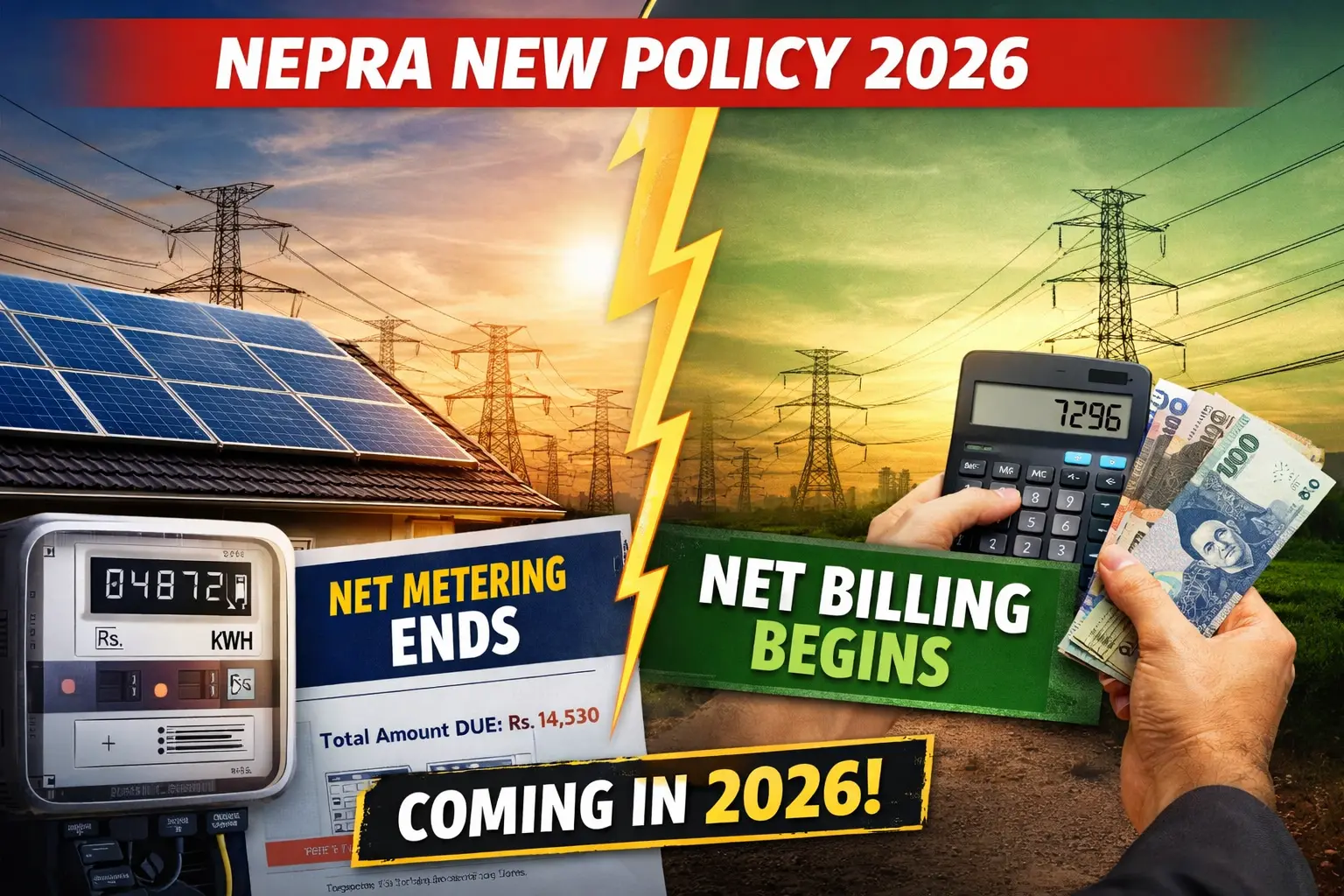
The NEPRA Net Billing 2026 policy marks a major transformation in Pakistan’s solar energy sector. The National Electric Power Regulatory Authority (NEPRA) has officially introduced the Prosumer Regulations 2026, replacing the Net Metering Regulations 2015 and fundamentally changing how solar consumers are billed across the country.
Under the NEPRA Net Billing 2026 framework, solar users will no longer receive one-to-one unit adjustments for electricity exported to the national grid. Instead, electricity consumed from the grid will be billed at the full applicable tariff, while surplus units exported to the grid will be purchased at the National Average Energy Purchase Price (NAEPP). NEPRA Official Website
This new system is expected to have a major impact on residential, commercial, and industrial solar users in Pakistan. For detailed guidance on electricity bills, check our guide: How to Check Electricity Bill Online in Pakistan.
Net Billing Replaces Unit-for-Unit Adjustment
Previously, under the Net Metering Regulations 2015, solar users could offset electricity consumed with the units exported to the grid. This system helped many consumers reduce their electricity bills and achieve a faster return on investment (ROI) for rooftop solar systems.
However, under the NEPRA Net Billing 2026, exported electricity will now be purchased at the national average energy price. Meanwhile, electricity consumed from the grid will be billed at the full consumer tariff, which includes taxes, fuel adjustments, and surcharges.
Billing will be calculated at the end of each 30-day cycle based on actual electricity import and export readings. This separation of export and consumption payments represents a significant policy shift for solar users.
Learn more about energy-saving tips and solar benefits in our article: Top Ways to Save Electricity in Pakistan.
Difference Between Net Metering and Net Billing
Under the old system, if a consumer exported 300 units and consumed 300 units, their bill would effectively be zero (excluding fixed charges).
With NEPRA Net Billing 2026, exported units are now purchased at the National Average Energy Purchase Price, which is usually lower than the retail tariff. Meanwhile, consumed units are billed at the full tariff. This means solar users may pay more compared to the previous net metering system.
Energy experts warn that the financial impact of NEPRA Net Billing 2026 may vary depending on system size, electricity consumption patterns, and future tariff revisions.
For more details on tariffs and billing, visit official tariff notifications.
Who Is Eligible Under the New Rules?
The NEPRA Net Billing 2026 applies to distributed generation facilities up to 1 megawatt (MW), including:
- Solar energy
- Wind power
- Biogas systems
Eligible consumer categories include:
- Residential consumers
- Commercial users
- Industrial connections
- Agricultural consumers
- General services
Consumers must be connected at 400V or 11kV and obtain proper interconnection approval from their respective distribution company (DISCO).
For the first time, biogas-based prosumers are also brought under the same regulatory structure, ensuring uniformity across renewable energy sources.
For more information on renewable energy options, see our guide: Complete Guide to Solar Panel Installation in Pakistan.
Net Metering Regulations 2015 Suspended
With the enforcement of NEPRA Net Billing 2026, the Net Metering Regulations 2015 have been officially suspended.
NEPRA emphasized that the updated regulations aim to:
- Standardize distributed generation across Pakistan
- Improve transparency in billing
- Align consumer-level power generation with national tariff policies
- Strengthen the financial sustainability of the power sector
Check out our Energy News in Pakistan category for more updates on national energy policies.
Contract Duration Limited to Five Years
Under the NEPRA Net Billing 2026, net billing contracts will remain valid for five years, after which consumers may apply for renewal for another five-year term.
This limited contract duration introduces periodic regulatory oversight and allows adjustments based on tariff revisions and national energy policies.
Impact on Solar Consumers in Pakistan
Energy analysts suggest that the shift from net metering to NEPRA Net Billing 2026 may extend the payback period for residential solar installations.
Since exported electricity is purchased at the National Average Energy Purchase Price, rather than the retail tariff, consumers may see reduced financial benefits compared to the previous system.
However, the new system offers several advantages:
- Greater transparency in billing
- Clear separation of export and consumption units
- Alignment with national energy pricing mechanisms
Solar remains a long-term solution for Pakistan’s rising electricity demand. Before installing a system, check our guide on Solar Panel Installation Cost in Pakistan for detailed cost analysis and ROI calculations.
Conclusion
The NEPRA Net Billing 2026 represents a major change in Pakistan’s renewable energy policy. While the end of net metering may reduce some financial incentives, the new system provides a more structured, transparent, and sustainable framework for distributed energy generation.
The long-term success of NEPRA Net Billing 2026 will depend on consistent regulatory enforcement and fair energy pricing policies. Consumers planning rooftop solar installations should carefully assess costs, expected returns, and the updated tariff structure before making decisions.
FAQs About NEPRA Net Billing 2026
What is NEPRA Net Billing 2026?
It is the new framework replacing net metering in Pakistan, where electricity exported and consumed is settled separately.
Has net metering ended in Pakistan?
Yes, under NEPRA Net Billing 2026, the Net Metering Regulations 2015 have been officially suspended.
Will solar users pay full electricity bills now?
Yes, consumers pay full tariff for consumed units while exported units are purchased at the National Average Energy Purchase Price (NAEPP).